
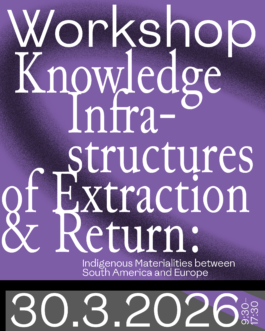
This symposium interrogates knowledge infrastructures not merely as cultural repositories, but as historical logistics of extraction that have moved indigenous aesthetic objects from the Global South to European institutions. Building on demands for reparation articulated by Kagaba, Mapuche, and Tupinambá representatives during recent dialogues in Lüneburg , we trace the specific "museum journeys" of these objects and the extractive mechanisms of collectors like Boris Malkin.
A central focus is the friction between the "supply" of artifacts—specifically the collections assembled by Dina and Claude Lévi-Strauss—and the current politics of restitution. We examine the lives and afterlives of these collections to address the epistemological effacement of objects often grouped without criteria in European institutions.
In counterpoint, the workshop highlights Apyãwa-Tapirapé resistance, exploring how "convivial pacts" and the strategic negotiation of ritual objects served as tools for demographic and ritual reestablishment. Finally, Tapirapé ritual specialists address the contemporary fight against extractivism—specifically the agrotoxic threats to their territories —seeking new alliances that transcend the museum to support Indigenous sovereignty and physical survival.
See also
→ Book of Abstracts

30 March, 9.30am to 6.30pm
Blue Square, Kortumstrasse 80, Bochum
With: Ana Coutinho, Susanne Leeb, Maria Luísa Lucas, Laura Sabel, Paroo’i Tapirapé, Ware’i Tapirapé; chaired by Tomaz Amorim and Jörn Etzold
This symposium interrogates knowledge infrastructures not merely as cultural repositories, but as historical logistics of extraction that have moved indigenous aesthetic objects from the Global South to European institutions. Building on demands for reparation articulated by Kagaba, Mapuche, and Tupinambá representatives during recent dialogues in Lüneburg , we trace the specific "museum journeys" of these objects and the extractive mechanisms of collectors like Boris Malkin.
A central focus is the friction between the "supply" of artifacts—specifically the collections assembled by Dina and Claude Lévi-Strauss—and the current politics of restitution. We examine the lives and afterlives of these collections to address the epistemological effacement of objects often grouped without criteria in European institutions.
In counterpoint, the workshop highlights Apyãwa-Tapirapé resistance, exploring how "convivial pacts" and the strategic negotiation of ritual objects served as tools for demographic and ritual reestablishment. Finally, Tapirapé ritual specialists address the contemporary fight against extractivism—specifically the agrotoxic threats to their territories —seeking new alliances that transcend the museum to support Indigenous sovereignty and physical survival.
See also
→ Book of Abstracts

30 March,
9.30am to 6.30pm
Blue Square, Kortumstrasse 80, Bochum
With: Ana Coutinho, Susanne Leeb, Maria Luísa Lucas, Laura Sabel, Paroo’i Tapirapé, Ware’i Tapirapé; chaired by Tomaz Amorim and Jörn Etzold