
Mining, industrialisation and monoculture have had a pervasive impact on living environments and communities on a global scale. Since the late 1950s, conventional coal mining in Europe has gradually come to an end. The remaining active mining areas are set to close within the next decade. The aftermath leaves behind places whose aesthetic conveys the passing of an era of prosperity. However, these places are also characterized by degraded soils, decaying infrastructure, and contaminated areas. In the Ruhr region, the transformation process began at an early stage, 'reprogramming' these places, as Rem Koolhaas put it. The transformation of the ruins into a cultural landscape, achieved by converting old mines into museums and theatres, as well as venues for the service sector, was intended to foster a sense of pride and identity in the region, while also attracting a new labour force.
Where this process is delayed by contaminated land, however, unique ecosystems
emerge whose flora and fauna have adapted to the often heavy-metal-laden soils. In
such contexts, the concept of 'landscape' as an aesthetic category becomes obsolete, highlighting the need for innovative and resilient forms of coexistence and solidarity. These places are characterised by loss, yet they also stimulate contemplation of an alternative mode of coexistence.
Taking place at the Künstler*innenhaus Dortmund, a former pithead building at the
Westphalia coal mine and part of the operational infrastructure of the mining industry, the symposium invites participants to reflect on the possibilities for cross-disciplinary collaboration and participation offered by an environment shaped by extraction. Within the framework of the concurrent exhibition project Unheimliche Verschiebungen by Urbane Künste Ruhr, the symposium will facilitate interdisciplinary discussions on the potential of industrialised landscapes, particularly those affected by past use and awaiting redevelopment.
The symposium will explore artistic research and participatory approaches interwoven with theoretical research. Can a landscape devastated by industrialisation ever become a place of solidarity, rather than conforming to the Romantic conception of nature?
Could the transformation from an industrial landscape to a cultural landscape occur
without reproducing extractivist patterns of thought and action? We will consider what we can learn from new ecosystems on brownfield sites and what rights we must grant to nature and its non-human agents after anthropogenic destruction and 'un-landscaping'.
See also
→ Book of Abstracts

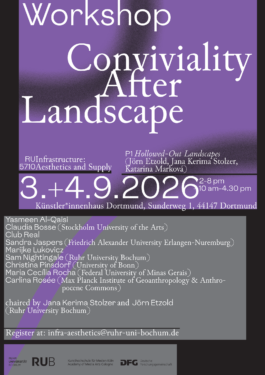
3 September, 14:00-20:00
4 September, 10:00-16:30
Künstler*innenhaus Dortmund, Sunderweg 1, 44147 Dortmund
With: Yasmeen Al-Qaisi, Claudia Bosse, Club Real, Sandra Jasper, Marijke Lukovicz, Sam Nightingale, Christina Pinsdorf, Maria Cecília Rocha, Carlina Rossée, Jörn Etzold, Jana Kerima Stolzer.
Attendance is free of charge.
Mining, industrialisation and monoculture have had a pervasive impact on living environments and communities on a global scale. Since the late 1950s, conventional coal mining in Europe has gradually come to an end. The remaining active mining areas are set to close within the next decade. The aftermath leaves behind places whose aesthetic conveys the passing of an era of prosperity. However, these places are also characterized by degraded soils, decaying infrastructure, and contaminated areas. In the Ruhr region, the transformation process began at an early stage, 'reprogramming' these places, as Rem Koolhaas put it. The transformation of the ruins into a cultural landscape, achieved by converting old mines into museums and theatres, as well as venues for the service sector, was intended to foster a sense of pride and identity in the region, while also attracting a new labour force.
Where this process is delayed by contaminated land, however, unique ecosystems
emerge whose flora and fauna have adapted to the often heavy-metal-laden soils. In
such contexts, the concept of 'landscape' as an aesthetic category becomes obsolete, highlighting the need for innovative and resilient forms of coexistence and solidarity. These places are characterised by loss, yet they also stimulate contemplation of an alternative mode of coexistence.
Taking place at the Künstler*innenhaus Dortmund, a former pithead building at the
Westphalia coal mine and part of the operational infrastructure of the mining industry, the symposium invites participants to reflect on the possibilities for cross-disciplinary collaboration and participation offered by an environment shaped by extraction. Within the framework of the concurrent exhibition project Unheimliche Verschiebungen by Urbane Künste Ruhr, the symposium will facilitate interdisciplinary discussions on the potential of industrialised landscapes, particularly those affected by past use and awaiting redevelopment.
The symposium will explore artistic research and participatory approaches interwoven with theoretical research. Can a landscape devastated by industrialisation ever become a place of solidarity, rather than conforming to the Romantic conception of nature?
Could the transformation from an industrial landscape to a cultural landscape occur
without reproducing extractivist patterns of thought and action? We will consider what we can learn from new ecosystems on brownfield sites and what rights we must grant to nature and its non-human agents after anthropogenic destruction and 'un-landscaping'.
See also
→ Book of Abstracts

3 September, 14:00-20:00
4 September, 10:00-16:30
Künstler*innenhaus Dortmund, Sunderweg 1, 44147 Dortmund
With: Yasmeen Al-Qaisi, Claudia Bosse, Club Real, Sandra Jasper, Marijke Lukovicz, Sam Nightingale, Christina Pinsdorf, Maria Cecília Rocha, Carlina Rossée, Jörn Etzold, Jana Kerima Stolzer.
Attendance is free of charge.